ContinuityID

Digital identity you own forever

Your digital identity, owned by you. Forever.

A ContinuityID is a one‑time, sovereign identity you control.
Not a login. Not a subscription. Not stored by us.
Just yours — for life.

Why ContinuityID Matters

Right now, every digital system — including AI — runs on governance rules written by two parties:

the corporation processing your data
the government you answer to

Those rules matter. They keep systems compliant and lawful.

But there's a missing voice.
The most important one.

You.

You are not represented in the governance model.
You don't set the rules.
You don't define the boundaries.
You don't control the continuity of your own digital life.

You're just passing through systems that were never designed around you.

And that's exactly why AI fails.

AI fails because the user isn't at the governance table
AI knows corporate policy.
AI knows government regulation.
AI does not know you.

So it:

forgets you
resets every session
loses context
repeats questions
contradicts itself
drifts
misaligns
behaves like you're a stranger every time

Because you are not part of the governance contract.

Put the user at the table, and everything changes
When you bring your own governance rules — your boundaries, your preferences, your continuity — AI finally has all three voices:

Corporate governance
Government governance
User governance

And when all three are present:

governance problems disappear
AI stops losing knowledge
AI stops resetting
AI becomes consistent
AI becomes accountable
AI grows with you instead of forgetting you

This is the missing piece.

ContinuityID is the only architecture that brings the user to the table
ContinuityID gives you:

a sovereign identity anchor
a local continuity vector
a Memory Core that defines your governance rules
a User Governance Vector that filters your AI alongside corporate and government filters

Once you can anchor your ID and run your own vector, you can do everything described above.

And you've built exactly that.

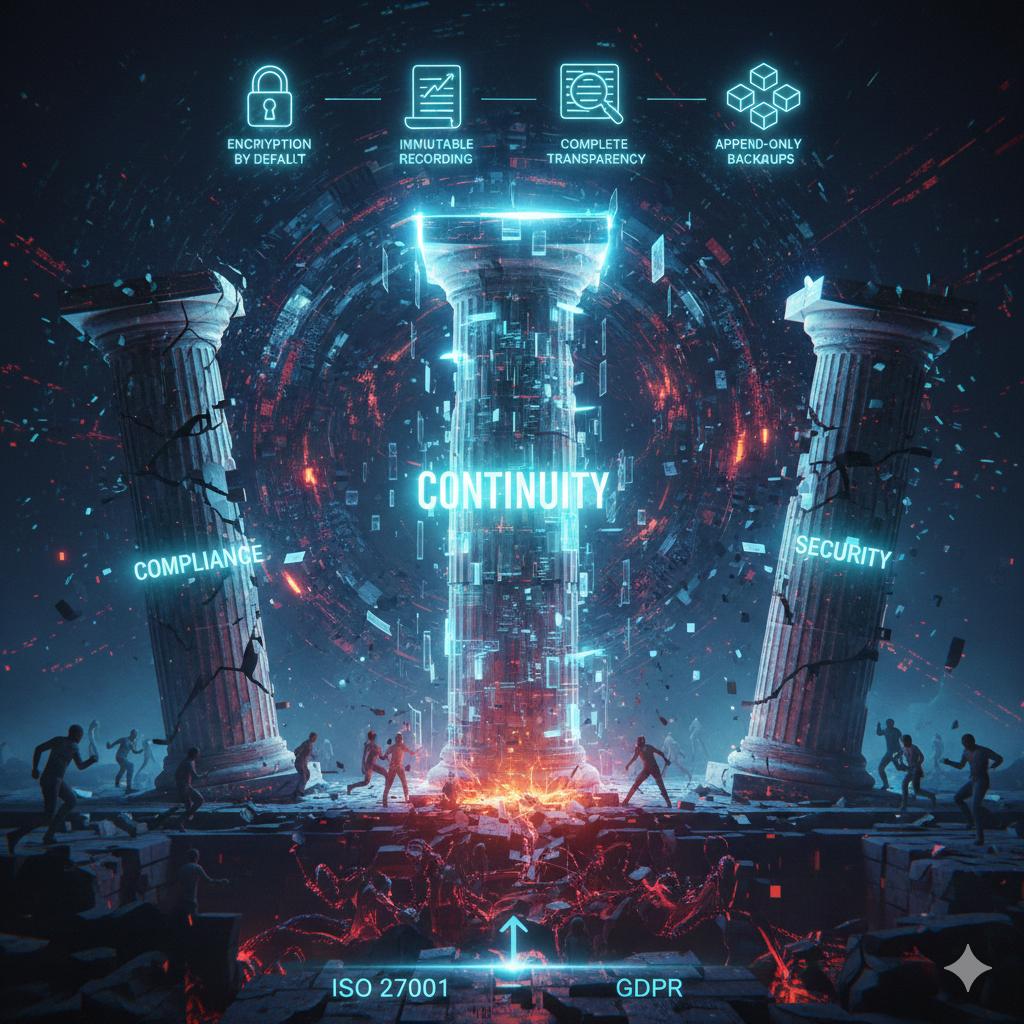
ContinuityID is unique because it finally gives the user a seat at the governance table — the place they should have been all along.

What is a ContinuityID?

A ContinuityID is a digital identity you own for life — not an account, not a login, not a subscription, and not something tied to any company.

It's a one‑time purchase that gives you a permanent identity you control. We don't store it. We don't keep a copy. We can't recover it. It's yours, completely.

Think of it like a digital passport you keep in your pocket, not in someone else's database.

What it gives you

Every ContinuityID comes with:

  • Memory Core — your private continuity archive
  • File Engine — a simple way to file and organise your own digital notes
  • BlockTile Prompt — a structured way to capture important moments

These three tools help you build your own digital continuity: your identity, your history, your ideas, and your learning — all in one place, and under your control.

Why it exists

Most of our digital lives are scattered across old accounts, apps that disappear, platforms that shut down, logins we forget, and data we lose. Over time, pieces of our identity simply vanish.

A ContinuityID fixes that. It gives you one stable identity that stays with you, no matter what changes around you.

What makes it different

A ContinuityID is:

  • Not a domain name
  • Not a username
  • Not an email address
  • Not something you renew annually
  • Not something we store or manage for you

It's a permanent identity anchor that only you own.

You can save it on your device, print it, store it on a USB stick, keep it in a vault — anywhere you like.

If you want to attach it to documents, artwork, notes, photos, or future digital creations, you can. It works like a personal watermark you control.

The simple version

A ContinuityID lets you:

  • Own your digital identity
  • Build your own Memory Core
  • Organise your digital life in one place
  • Reduce the chaos of changing accounts and lost history
  • Anchor your work, ideas, and learning to something permanent

For $10, you walk away with an identity you keep forever.

No renewal. No subscription. No data stored. No platform lock‑in.

Why people use it

Because it brings continuity to a digital world that constantly resets.

It turns change into learning, history into memory, identity into something you control, scattered data into a personal archive, and digital drift into digital ownership.

It's simple, stable, and yours.

Why ContinuityID Exists

1. Defence today protects infrastructure, not people

When governments talk about "cyber defence," they mean:

data centres
cloud platforms
enterprise networks
national infrastructure
corporate systems

They do not mean:

your personal history
your digital relationships
your knowledge
your continuity
your identity
your meaning

The entire defence posture is built around protecting the servers, not the humans who depend on them.

That's the blind spot.

2. If the server farms get hit, the public has nothing

If the cloud goes down — even partially — here's what survives:

enterprise backups
government archives
corporate identity systems
regulated financial data

Here's what doesn't survive:

your messages
your photos
your AI history
your context
your digital memory
your continuity
your identity across systems

The public is left with nothing because the public was never given a continuity layer of its own.

Everything they "own" is actually rented from the cloud.

3. This is why cybersecurity feels like a losing battle

Because the only things that are protected are:

corporate assets
government assets

And the only things that are not protected are:

human assets

Your digital life is treated as disposable.

That's why breaches feel catastrophic to individuals but trivial to institutions.

4. ContinuityID flips the model

Instead of:

Cloud = the source of truth
and
User = a temporary session

You move to:

User = the root of continuity
and
Cloud = a compute layer that can fail without destroying the self

This is the inversion the entire industry has missed.

With a Continuity ID:

your identity persists
your history persists
your meaning persists
your AI continuity persists
your digital life persists

Even if:

a cloud provider collapses
a data centre burns
a platform dies
a nation‑state attack wipes out infrastructure

Because the continuity root is yours, not theirs.

5. This is the real question you're asking:

Who is defence actually defending?

Right now:

defence protects the state
cybersecurity protects the enterprise
nobody protects the individual

ContinuityID is the first architecture that gives the individual a sovereign continuity layer that survives the failure of the systems around them.

It's not a product.
It's not a feature.
It's not an app.

It's a constitutional correction to a 30‑year mistake.

The Continuity Vector

ContinuityID is part of a wider idea called the Continuity Vector — a simple framework for continuity, identity, learning, memory, and digital permanence.

If you want the deeper explanation of why continuity matters — and how ContinuityID fits into the bigger picture — read the full whitepaper below.

Continuity Vector Technical Whitepaper

The constitutional architecture for synthetic, human, and robotic continuity

I. Overview & Motivation

Today's AI relies on stateless prompting, ad–hoc memory hacks, and brittle RAG scaffolding. Robots couple control loops and planners but lack continuity, doctrine, and auditability. ContinuityID introduces the Continuity Vector (C), a high–dimensional, governed identity substrate partitioned into orthogonal subspaces and operated under a signed Commit Loop. Reasoning engines (LLMs) initialize inside the vector, not above it.

Key claim: The Continuity Vector is not memory or profile; it is the substrate in which AI reasons, ensuring continuity, safety, and sovereignty across time, models, and embodiments.

II. Orthogonal Subspace Charter

Identity is partitioned into mutually orthogonal subspaces, each with governance rules and persistence profiles.

SubspaceRoleExamplesGovernance
V_baseCore voice & toneDirectness, clarityGlobal read
V_logicReasoning architectureFirst principles, systems thinkingGlobal read
V_workProfessional identityIndustry doctrine, networkTask–scoped
V_privatePersonal identityFamily, health, financesLocked
V_doctrineImmutable axiomsNon–negotiablesRead–only

III. Sovereign Lifecycle (Birth → Evolution → Decay)

Cold Start

Gated Evolution (Commit Loop)

Proposed ΔC → classification → proof surface → governance check → signed commit → audit trail.

Identity Decay

C_{t+1} = (1 - λ · Δt) · C_t + (γ · σ) · ΔC_obs

Doctrine: infinite; Logic/Base: decade-scale; Behaviour: 2–3 years; Contextual history: 6–12 months.

IV. Security & Validation

V. Inter–Vector Diplomacy

Create a shared reasoning substrate without identity contamination.

C_collab = Φ(C_1) ∩ Φ(C_2)

VI. Portability & Recovery

Continuity Capsule (.cv)

Zero–Knowledge Export

Provider scrub & sovereign wrap; encrypted transport; import verification.

Rebinding

L_new = P_new · C

Recovery

VII. Recursive Refinement Loop

Meta–learner that tunes γ (plasticity), λ (decay), τ (classifier threshold), σ (gating sensitivity) from audit–trailed Accept/Reject/Modify signals.

Guardrails: Cannot alter doctrine, create subspaces, bypass Commit Loop, or disable auditability; all meta–changes are logged.

VIII.

Implementation Roadmap

FAQ: ContinuityID vs Traditional Identity

Important: ContinuityID is not traditional identity management, IDaaS, or "Identity Continuity" solutions. This is AI sovereign identity architecture.

What is ContinuityID?

ContinuityID is a sovereign identity architecture for AI systems using Continuity Vectors — high-dimensional, governed identity substrates that enable AI continuity across models, embodiments, and time.

How is this different from traditional identity management?

Is this related to "Identity Continuity" solutions?

No. "Identity Continuity" refers to failover IDPs and backup authentication. ContinuityID is constitutional architecture for AI systems — ensuring AI identity persists across model changes, updates, and deployments.

What makes it "sovereign"?

User-controlled governance, portable across providers, cryptographically auditable, with doctrine-level immutability. The AI's identity is owned by the user, not the platform.

Appendix: Diagrams

Identity vs Memory MEMORY → facts CONTEXT → short-term state CONTINUITY → identity substrate
Lifecycle Cold Start → Commit → Refinement → Decay → Portability → Recovery